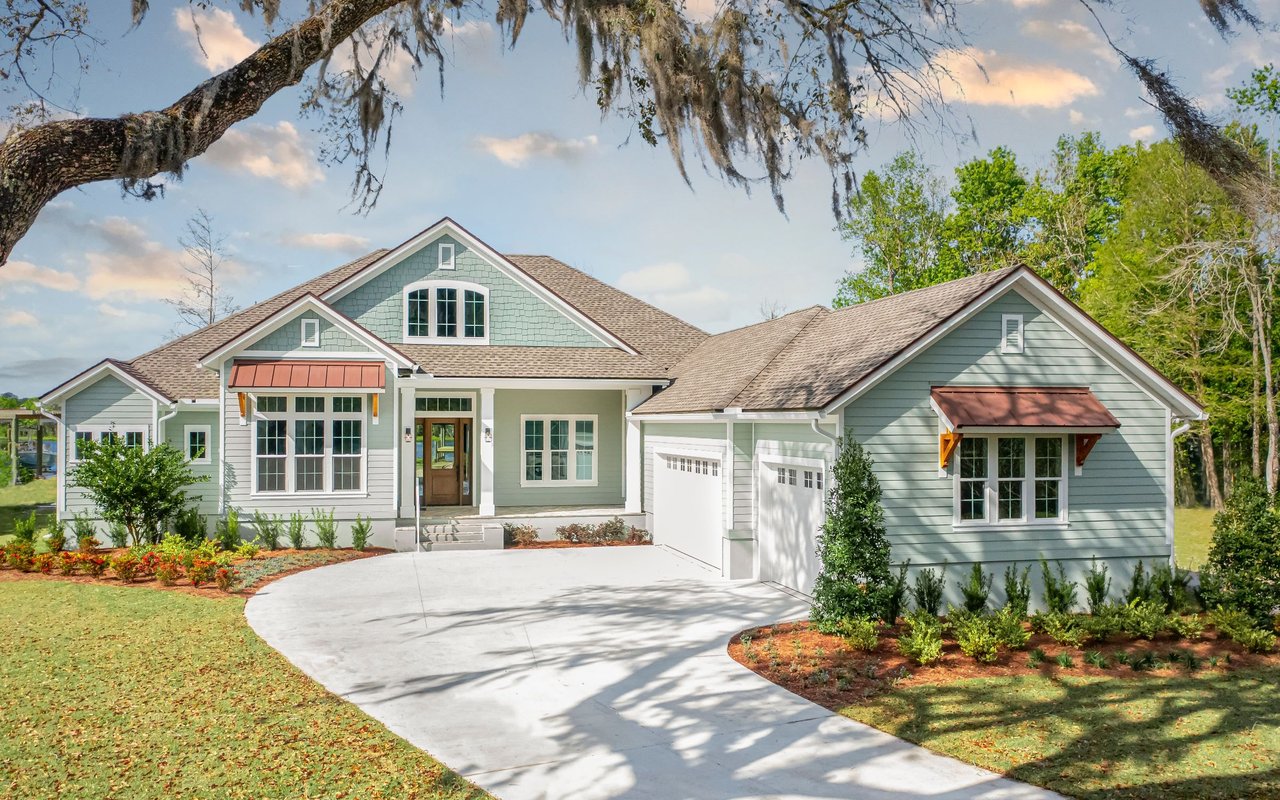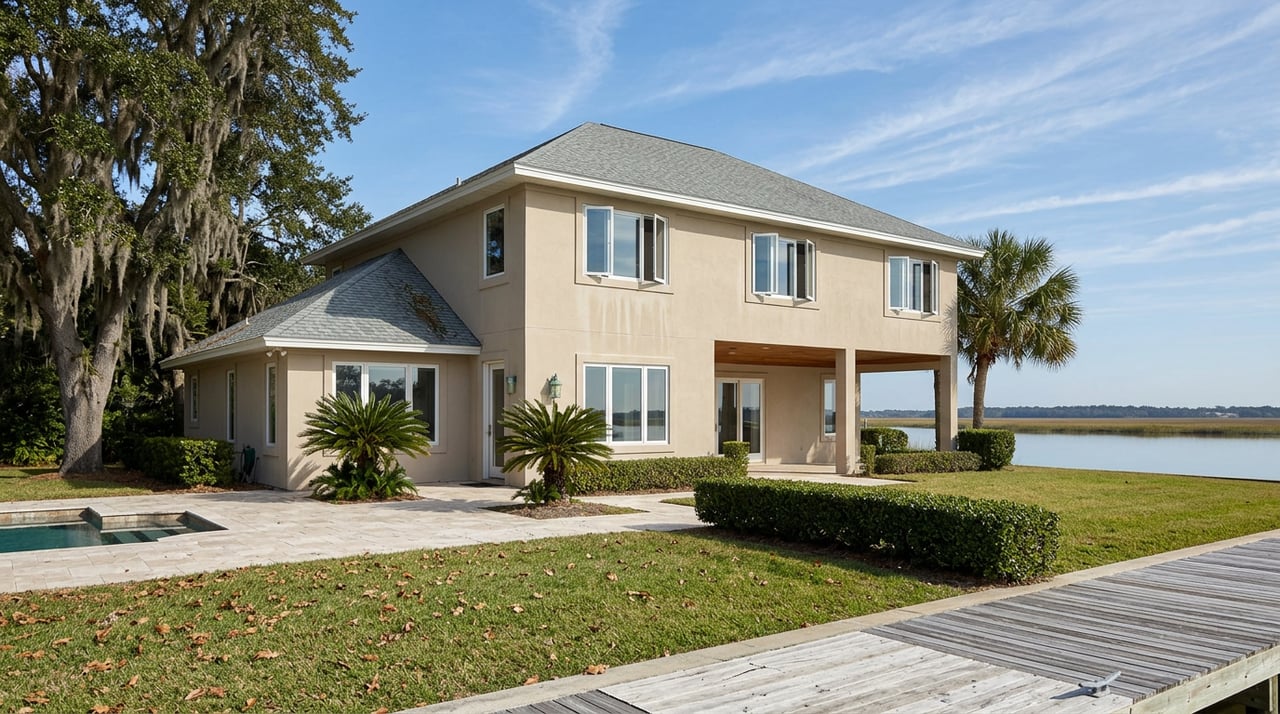
If you have been comparing Northeast Florida gated communities on a portal, you have probably already seen Queen's Harbour's number. What you may not have seen is that the number moves in a direction that shouldn't happen in a normal market: over the twelve months ending in July 2026, the median sold price in this Jacksonville community came in higher than the median list price of homes currently for sale. Sold homes outpricing the active listings is not how a typical market behaves, and it is not a typo. It is what happens when a neighborhood sells so few homes in a year that a handful of closings can swing the whole picture.
That distinction matters if you are cross-shopping Queen's Harbour against other gated, golf, or waterfront communities in the area. The headline price tells you almost nothing about what a specific home will cost you. The mechanics behind that price, and the layered cost structure sitting on top of it, tell you a lot more.
A market too thin to trust a single number
Queen's Harbour is a roughly 1,000-home community built out starting in 1990 on a peninsula bordered by the St. Johns River, Greenfield Creek, and the Intracoastal Waterway. In a community that size, six closed sales in a twelve-month stretch, which is what current MLS activity showed as of early July 2026, works out to a turnover rate of roughly six-tenths of one percent. Fewer than seven homes out of a thousand changed hands in a full year.
That is the reason the median sold price landed at $1.5M against a median list price of $1.3M on active inventory at the same moment. With only six data points feeding the sold-price side of that comparison, one or two high-value closings on renovated lagoon-front or golf-front lots can pull the median well above whatever the bulk of current listings are asking. A market this thin does not average out the way a neighborhood with hundreds of annual sales would. Every closing carries outsized weight.
The same distortion shows up on the active side. Current listings in the community span a wide range, from the high $600,000s up toward $3.5 million, with average asking prices well north of the median list price because a few ultra-high listings pull the average up while the median stays anchored by the bulk of ordinary listings. If you only look at "average price" or "median price" as a single figure, you are letting a small number of outlier homes do the talking for a market that mostly consists of something more modest.
The practical takeaway: in Queen's Harbour, a single median or average figure is close to useless on its own. What matters is the closed comp for a home similar to the one you're considering, not the neighborhood-wide summary statistic sitting on a listing page.
Renovation age shapes which sales pull the median where
Part of why closed sales can swing so high is the age of the housing stock. Much of Queen's Harbour's inventory dates to the 1990s and early 2000s, meaning a meaningful share of homes on the market at any given time are candidates for updating rather than move-in ready. A dated but structurally sound home on the lagoon and a fully renovated home a few streets over on the same footprint can occupy very different price tiers even though a portal search would group them together. When one of the renovated homes closes, it can single-handedly move the community's median for the year. That is not a flaw in the data. It is exactly what you'd expect from a small, mostly older housing stock where condition, not just location, does a lot of the pricing work.
The price on the sign is not the only bill
Here is where Queen's Harbour differs from a lot of neighborhoods buyers cross-shop against it: the purchase price is only one of three separate financial commitments, and they come from three different organizations with three different rules.
| Organization | Mandatory or optional | What it covers |
|---|---|---|
| Queen's Harbour Owners Association | Mandatory for every homeowner | Gated access, common areas, community-wide governance |
| Queen's Harbour Country Club | Optional | 18-hole golf course, tennis, dining, part of the Invited network of clubs |
| Queen's Harbour Yacht Club | Optional, separate from the Country Club | Boating and social events, $350 per household for the 2026/2027 membership year |
Buying a home here automatically makes you a member of the Owners Association, the master HOA that governs the gated entry and common infrastructure. There is only one sub-association layered under it, the Providence Island Owners Association, which applies to residents of the Providence Island townhome enclave.
The golf and dining side of the community, the Country Club, is a separate and optional membership now operated as part of the Invited network, the same group that manages more than 300 country and business clubs nationally. Its 18-hole course was designed by Mark McCumber and has hosted events including a PGA Tour Qualifier and the Mercedes Collegiate Championships. Joining is not required to live in the neighborhood, but golf, tennis, and clubhouse dining access all run through this membership rather than through your HOA dues.
Then there is the Yacht Club, which is its own volunteer-run organization entirely separate from the Country Club, dating back to 1993 when Harbormaster David Cawton and first Commodore Bob Pitman got a group of neighbors together to charge $40 a head and throw the community's first cookout. Today it costs $350 per household for a full membership year, a fraction of what a golf or country club membership typically runs, and it centers on boating events and the marina rather than golf or tennis.
If you are pricing out what it actually costs to live in Queen's Harbour, the sale price gets you the house and mandatory HOA membership. Everything involving the golf course, the clubhouse, or the yacht club calendar is an additional, optional line item you choose separately, at a separate price point, from a separate organization.
Why the water access shapes which homes carry the premium
The physical layout explains a lot about which homes drive those high closed sales. The neighborhood sits on a spring-fed, non-tidal lagoon that connects to the Intracoastal Waterway through a navigational lock, keeping water depth at eight feet or more regardless of tide. That lock system lets boats with tall masts and fishing towers pass through without the clearance problems you'd hit on a typical tidal waterway, and it feeds a marina with 65 boat slips plus another 10 personal watercraft ports.
Homes that back directly onto that lagoon get private boat access most tidal communities can't match. That is a meaningful reason lagoon-front sales can land well above the community's typical asking price, and why a single closing on one of these lots can be the outlier dragging the annual median upward. If you are comparing a golf-front lot to a lagoon-front lot in the same subdivision, you are not comparing the same product, even though both would show up under the same neighborhood name on a portal search.
One more location detail worth knowing if you are cross-shopping by school zone: homes here are zoned to Neptune Beach Elementary and Duncan Fletcher High School, despite Queen's Harbour sitting inside Jacksonville's city limits rather than in the beach towns themselves. That zoning quirk surprises some buyers who assume attendance zones follow city boundaries.
What this means if you're comparing Queen's Harbour to another community
Do not let the portal's median or average price stand in for the actual comp you need. Ask for closed sales on homes similar in age, waterfront type, and renovation status to the one you're considering, not the community-wide figure. Ask separately about HOA dues, Country Club membership costs, and Yacht Club dues, since none of the three are bundled and none of them are optional to skip if you want full access to the amenities that make this community what it is. And if a lagoon-front or golf-front lot is priced well above what you've seen quoted as the "median," that premium is often the water access or the course frontage talking, not an inflated ask.
A few quick questions
Is Country Club membership required to buy a home in Queen's Harbour? No. The Owners Association is mandatory for every buyer, but the Country Club, which includes the golf course and clubhouse dining, is optional and billed separately.
What is the difference between the Yacht Club and the Country Club? The Yacht Club is a separate, lower-cost organization ($350 per household for 2026/2027) focused on boating events and the marina. The Country Club is a larger optional membership through the Invited network covering golf, tennis, and dining.
Why are so many homes in Queen's Harbour candidates for renovation? The community was built out starting in 1990, so a meaningful share of the housing stock dates to the 1990s and early 2000s. Condition varies significantly from block to block, which is part of why closed sale prices can vary so widely even within the same community.
If you're weighing Queen's Harbour against other Northeast Florida communities and want the actual closed comps behind a specific home, rather than a neighborhood-wide average, Michael Wright can walk you through what a particular lot, lagoon frontage, or renovation status is really worth right now. Contact Us to start that conversation.