If you live in Queen's Harbour and it's a Thursday evening, where do you actually end up? Down at the marina watching a sportfisher clear the lock, or in the ballroom for trivia night, buying in for a shot at the cash jackpot?
For most residents, it's the second one. Not because the boating identity is fake. It's because the boating identity was built around a very small number, and everything else in the neighborhood has been built around a much bigger one.
The Number the Brochure Doesn't Mention
Every description of Queen's Harbour leads with the same image: a private lock, styled after a small-scale canal system, that lifts and lowers boats between the community's freshwater lagoon and the Intracoastal Waterway. It's a genuinely unusual piece of infrastructure for a residential neighborhood, and it earns the attention.
But the marina it protects has a hard ceiling. The Queen's Harbour Yacht and Country Club lists 65 slips on fixed concrete docks, sized to handle vessels up to 100 feet with metered 30- and 50-amp power. That's not a number that grows. There's no adjacent parcel to expand into, no phase two. Sixty-five slips is what the harbor has had and what it will keep having.
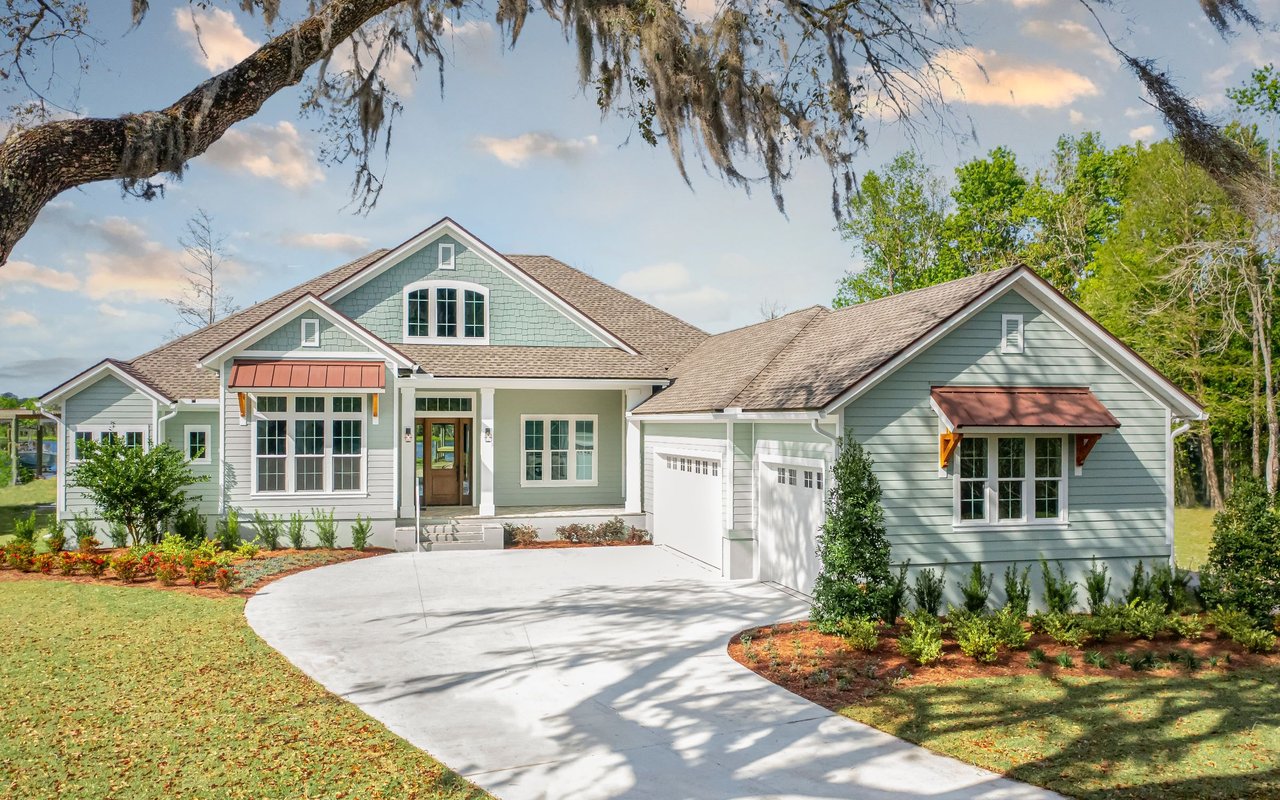
Meanwhile the neighborhood around it has grown to roughly 1,000 homes since development began in the early 1990s, spread across about 1,100 acres bounded on three sides by the St. Johns River, Greenfield Creek, and the Intracoastal itself. Some of those homes sit directly on the lagoon with private docks, so the marina isn't the only way to keep a boat here. But for everyone else, the shared harbor is it, and it was never going to scale with the neighborhood.
That mismatch matters less as a complaint and more as a clue. If the water-side amenity is fixed in size, the land-side amenities are where a neighborhood this size actually has room to grow. And that's exactly what's happened.
A Club That Never Required a Boat
The oldest social institution here isn't the country club. It's the Yacht Club, and its own history page tells the founding story better than any summary could. In early 1993, Harbormaster David Cawton approached the community's first Commodore, Bob Pitman, about starting a club. They pulled in a few others, Rodney Lay and Scott Weiland among them, set dues at $40 a person, and within a month had $4,000 in the bank. The first move with that money was a party: about 20 boats headed up to Fort George. The first fishing tournament produced nothing but empty coolers, so Pitman bought steaks at Publix and they grilled instead.
What's easy to miss in that story is a detail the club states plainly on its own membership page: it has never been a requirement to own a boat. Membership has always been open to residents, Country Club members, and marina slip lessees alike. The Yacht Club still runs First Mates gatherings, member trips, and the annual Commodore's Ball, and it still co-sponsors the neighborhood's Christmas Lighted Boat Parade. But it was designed from year one as a social club that happened to be organized around water, not a boat owners' association. That distinction is why it has outlasted any single marina's capacity.
What Actually Got Built After the 2023 Vote
The clearest evidence that the neighborhood's growth has moved to land came in May 2023, when Queen's Harbour homeowners approved what the POA calls the Campus Amenity Project. The finished project centers on a new open-air pavilion built to seat 250 people, with a prep kitchen fitted with commercial-grade equipment, ample storage, and multiple restrooms. Out front, a paved sitting area runs under an end-to-end pergola with a gas firepit and outdoor grills, built for exactly the kind of resident gatherings and club events that used to have nowhere purpose-built to happen.
Alongside the pavilion, the project added four dedicated pickleball courts plus two shared multipurpose courts that double for basketball, a junior-size basketball court, expanded playground equipment, a new walking path, and additional vehicle and golf cart parking. The dedicated pickleball courts run open from 7 a.m. to 10 p.m. every day of the week, split between reserved play and open play. Sixty-five slips can only ever serve 65 boats at a time. Four courts running fourteen hours a day, seven days a week, can absorb a lot more traffic, and it shows.
The country club, managed by Invited, keeps a recurring weekly rhythm that fills out around that new infrastructure. This summer's schedule has looked something like this most weeks:
- Thursday evenings, Trivia Night in the clubhouse, $25 for members and $30 for guests, plus a $5 cash buy-in per person for a winner-take-all jackpot
- Friday evenings, Nine & Dine, with check-in at 5 p.m. and tee-off at 5:30, priced at $35 per couple for golf members and $55 for social members and guests
- Saturday evenings, a Wine Dinner in the clubhouse
- A Member-Member golf tournament series that ran across two days in mid-July
Outside groups have taken notice too. The North East Florida Senior Golfers Association has a round booked at Queen's Harbour for Monday, October 19, 2026, a 9 a.m. shotgun start with blind bogey scoring, gross skins, and a closest-to-the-pin contest, played on the club's 18-hole course, a Mark McCumber design carved through native woodland and marsh.
The Club Nobody Had to Approve
Maybe the best evidence that pickleball has become the neighborhood's real social engine is that residents didn't wait for the HOA to organize it. Alongside the official POA courts, there's a resident-run Queen's Harbour Pickleball Club that coordinates through its own Facebook group rather than through the property management office. Nobody voted on it. Nobody had to. Enough people wanted regular games that they built the scheduling themselves, the same organic way the Yacht Club got its start with nothing more than $40 in dues and a plan to head up to Fort George.
That's the pattern worth noticing. The Yacht Club, the Country Club calendar, and now the Pickleball Club all share the same origin story: a handful of residents deciding the neighborhood needed a standing reason to gather, then building it themselves. The lock and the marina are the postcard. The book club, bridge group, garden club, wine club, and now the pickleball group meeting on courts that didn't exist three years ago are the actual week.
None of this makes the marina less real or the lock less worth watching on a Saturday morning. It just means that if you're picturing daily life here as boats and bow lines, you're picturing the smaller half of it. The bigger half is happening on a paver patio under a pergola, or on a court that's booked solid before most people have had coffee.
If you're weighing a move to Queen's Harbour, or you're already inside the gates and want a read on what a specific section or listing actually offers day to day, Michael Wright and Suzi Ford know this community beyond the marketing copy. Contact us for a straight, low-pressure conversation about what living here really looks like.